📚 Book takeaways Refactoring by Martin Fowler
Table of Contents
In these call-outs I flag my personal opinion or additions. Like for other books, this post reflects my learnings and opinions. It does not aim for a true representation or summary of the book. Some chapters (like the one about self-testing code) are missing completely, because I honestly did not feel like this book is a good way to learn about tests compared to books which are focused on modern test strategies.
I very much changed the structure of the book. As a reader I may enjoy the freedom of reading it the way I please and find easy to follow, regardless on the structure the author envisioned. In this case this means, Martin Fowler offered one chapter of code smells linking to the following chapters of categorized ways of refactoring with examples; while I will present here a selection of code smells with examples and the best fitting refactorings to fix them. The code examples are all self designed code smell asci monsters (even if they look like a tree).
Refactoring #
Refactoring is a code change that does not change the external behavior of the Code.
It should be driven by change, not by personal opinions on code aesthetics.
Reasons and moments to refactor could be:
- If a new feature should be implemented, and there is no simple way to add the new code
- Reducing the future cost of change. Modularity can improve the speed in which new functionality can be added (if we are aware of the upcoming functionality)
- Emphasize architecture decisions that sometimes get buried under short term decisions
- Comprehensive Refactoring to understand complicated code
- Litter pickup to always leave the code cleaner that you encountered it
- Refactor as review style
Refactoring can always be performed step by step, with reliable tests running, and do not need a massive change of the code base with hours of trying to get a now completely different code running to the same tests. Every refactoring is possible in a loop of one line change, tests passing, and the next one line change. Need to refactor a property into a getter? Write the getter, replace property access by property access with the getter. Need to extract a function (and don’t want to use the IDEs refactor function)? Move it line by line into the function, while keeping the tests passing. Having a hard time with many variables? Replace them with function calls during refactoring to enable you to move slowly with passing tests.
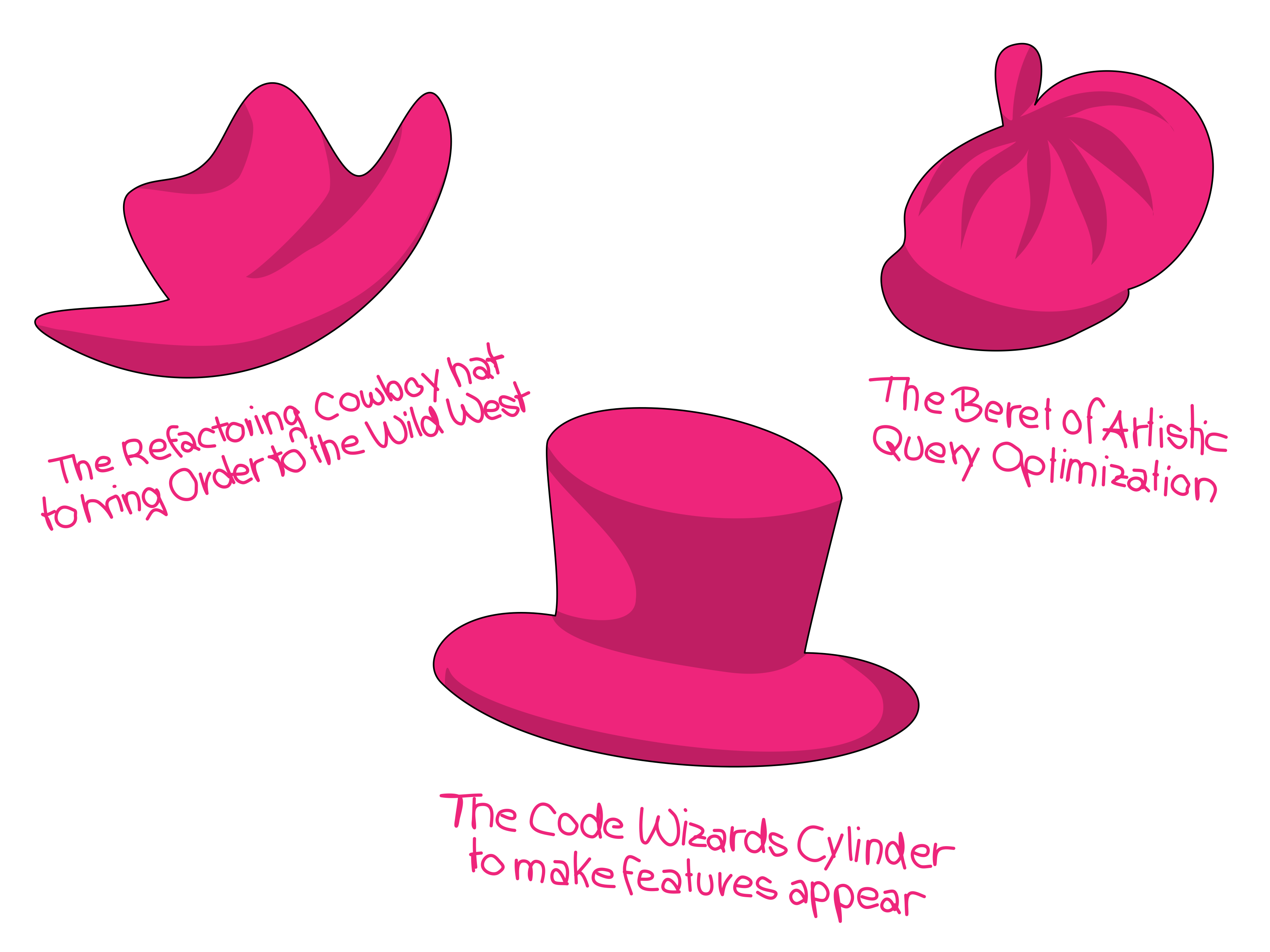
Because refactoring does not change the external behavior, it can be completely separated from feature development,
coining the phrase First make the change easy, then make the easy change. This emphasizes feature adding and
refactoring are two steps, valuing different skills and knowledge, and aiming for different goals - different jobs that
can be imagined as two hats be worn to different occasions, never simultaneously.
Refactoring and Performance #
Most performance issues are located in a very small fraction of the code. Most of the time, refactoring makes it easier to identify and tackle those bottlenecks, which in practise is often more relevant than performance drawbacks from refactoring e.g. running through the same loop twice to separate two steps of processing.
In most cases, replacing a variable with a query does not harm the performance in a way that matters, but it can be a good idea to check if the query is expensive to execute before doing this refactoring. By expensiveness, I don’t mean algorithmic complexity growing from O(n) to O(2n), but more excessive database queries that cost measurable amounts of resources in a software system.
Many arguments regarding performance because of refactorings in my experience are not based on actual measurements, but rather on a gut feeling, that often not even accounts for the languages / compiler specific optimizations. If a refactoring causes a measurable performance decrease (to which I would call number of database queries), then the refactoring is questionable.
Code Smells #
Mysterious Name #
Naming is hard, and renaming a function, property, or variable is one of the most common refactorings. While it is easy to call out “rename it” as a solution, complicated names can often be a sign of deeper design issues.
def caliginous_string() -> str:
    return (f"""
      -------
      │  ?  │
    dbqpdbqpdbq
      ( o.o )
      @≥ - ≤@
    """)
Change the declaration of a function, property or variable #
Functions represents building blocks of the software system. A well-defined function name can replace the need of finding out what the function does and how it is used. This also applies to parameters, properties and variables - a clear names enables the future developer to understand the code, its purpose and how it is used without needing to read the implementation. The more widely something is used, the more important is the clarity of its name.
Duplicated Code #
Using the same code in multiple places can indicate a missed opportunity for abstraction. Abstracting would emphasize the differences between similar code, instead of costing the reader time to question if there is a difference. If the difference might even be big and consistent enough to be separated into multiple functions.
To ensure euphoric deduplication is not making the code more complex than it needs to be, the “Rule of three” can be used as a guidance to allow duplications until at least three variants did present themselves to understand how different variants might behave.
def twin_monster() -> str:
    return (f"""
      -------
      │  ?  │
    dbqpdbqpdbq
      ( ^.^ )
      @≥ - ≤@
    """)
Slide (Move) Statements #
Code is easier to understand when related statements are close to each other. Sliding statements means moving statements together. This can be a preparation for an Extract Function.
Long Function #
A long function hides where the main logic is defined, and will cause every reader time to parse through the entire function to understand it and where the new feature should be placed. This can be avoided by shortening and structuring the function in way, that makes it easy to understand and place a new feature. The main goal should not be to reach a maximum line number a function should have, but to separate intention and implementation. A function should have a specific reason and context to exist in, which might be a concrete implementation, or stating an intention that calls implementations.
from datetime import datetime


def long_function_monster() -> str:
    now = datetime.now()

    # Start building the snake
    snake = "    ___   \n"
    snake += "  >{_σ │  \n"

    # Changed to left turning snake by 2020
    if now > datetime(2020, 3, 15):
        snake += "      \ \  \n"

    # Rolling release in 2025
    if now > datetime(2025, 11, 1):
        snake += "   ____) )\n"
        if now < datetime(2025, 1, 10):
            snake += " / _____/ \n"
        if now < datetime(2025, 3, 1):
            snake += "( (___    \n"
        if now < datetime(2025, 5, 1):
            snake += " \___ \   \n"
        if now < datetime(2025, 7, 1):
            snake += "     \/   \n"

    # Feature flag with auto enable in 2022
    if now < datetime(2022, 6, 20):
        snake += " \___ \   \n"
        if now > datetime(2022, 9, 1):
            snake += "     \/   \n"
        else:
            snake += "  ___/ /  \n"

    if now > datetime(2023, 2, 14):
        snake += " / _____/   \n"

    if now < datetime(2023, 7, 4):
        snake += "( (___ __ \n"
        if now > datetime(2023, 10, 31):
            snake += " \_____  \\n"
            # Parse the override string
            pass

    # Special handling for empty results (added for client X)
    if now < datetime(2024, 4, 1):
        snake += " / _____/ \n"

    # Tail handling
    snake += "( (___    \n"
    snake += " \___ \   \n"
    snake += "     \/   \n"

    return snake
Similar to this, Large classes cause the same problems, which might or might not allow the extraction of whole class. Additionally, here identifying and replacing possible subclasses with different types might help, this way properties and functions that only belong to some subtypes are moved out of the way to only leave the things that are common and used among all subclasses.
Extract a Function #
A function symbolizes a differentiation between intent and implementation. Extracting a function means replacing the old code fragment with a function call named after the intent of the code fragment. The parameters of the extracted function highlight dependencies and differences between its usages. With this goal in mind, having a function that just hase one line of code can be valid if it describes the intent of the code fragment better than the code fragment itself. In that way extracting a function can replace the need of a comment.
A large block of code can have a clearer intention if the code blogs within conditionals are extracted, leaving just the conditional easily readable in the original function. How the conditions are structured can also have drawbacks and benefits. Sometimes it is a clean solution to have on consolidated check that replaces a big nested check can make things easier to understand than a big conditional with many branches.
Pulling up a method means moving a method from a subclass to its superclass. This is useful when the method is duplicated in multiple subclasses, or only differs in small parts, naming, or parameters.
One hint, that a function is too long and should be splitted. If a variable is the result of a complex calculation, but is then re-assigned, that can be a sign that the function and that variable is doing too much and might work better splitted.
Replace Variable, Property, or Parameter with Query #
Variables or Parameters can capture and name a value, but they also introduce something the developer needs to keep in mind. Replacing variables with small functions can make the code easier to read and to perform other refactorings because the local dependency of the variable is removed.
Replacing properties with queries can also remove mutable data that can also be calculated freshly, removing any danger to corrupt or stale the value.
Replacing a variable with a query only makes sense if the redone calculation of the variables will not change the outcome. While formatting for example would always produce the same result, a database query might produce different results each time it is executed (which can be intentional in the same function, but sometimes is not).
Replace Function with Command #
A command in this context is a function that is encapsulated into an object. In this form, the function can have its own set of subfunctions and properties. This can be useful when the function is too complex to be easily understood, or when it is intended to be used as a single unit of work that can be executed, undone, or queued.
Replace Conditional with Polymorphism #
Complex conditional logic is often the hardest thing to code in a readable, intuitive way. One way to solve this is to separate the conditions into different circumstances that are wrapped into different subclasses, each handling an understandable subset of the conditional logic. This can be Variants with given parameter options, variants that match certain assumptions, or variants that belong to different types.
Split Loop (intp Pipeline) #
It is a common anty pattern that a loop is used to do things at the same. This comes with the drawback, that whenever the loop is touched, both things need to be understood. Splitting such a loop into two loops, each doing its own task, can be a good solution for that. Many hesitate to do this because of performance concerns, which are covered in Refactoring and Performance
If that loop does multiple things, this can be further clarified by using Pipelines like Map, Filter, Reduce to further emphasise how the data is processed.
Long Parameter List #
Long parameter lists happen, sometimes for historic reasons, sometimes because more and more functionality was added over the iterations. It indicates in any case that the behavior of functions may vary in many ways, which ways exactly is obfuscated by the number of variables that the reading developer needs to keep in mind to parse the function.
One straight forward way is to replace a Parameter with Query to reduce the number of parameters, although this would keep the coupling.
def parameter_hungry_monster(
        has_teeth: bool,
        teeth_count: int,
        tongue_count: int,
        tonsils: bool,
        extra_jaw_size: int,
) -> str:
    teeth_count = max(min(teeth_count, 5), 0)
    monster = " _" + "_" * teeth_count + "δδ) \n"
    monster += "() " + " " * teeth_count + " | \n"
    monster += "  " + ("v" if has_teeth else "~") * teeth_count + "\ |\n"
    if tonsils:
        monster += " " * teeth_count + "   |│\n"
    for tongue in range(tongue_count):
        monster += " >≈" + "≈" * teeth_count + "|│\n"
    for extra_jaw_size in range(extra_jaw_size):
        monster += " " * teeth_count + "   |│\n"
    monster += " (" + "^" * teeth_count + "  │ \n"
    monster += " " * teeth_count + "ΣΣ ß"
    return monster
Introduce Parameter Object #
Often a set of parameters travel together even through multiple functions. Such data clump can be replaced by a data class, emphasizing their relationship. Also, this will make the code more consistent and reducing the parameter list. They also open up the possibility to restructure the code around this new-found abstraction.
It sometimes happens that a couple of properties of an object are separated just to be put into one function. This is prone to future touches as any change of the object might require touching the function. This can be avoided if the whole object would become the parameter. Although sometimes the dependency to the object can be a problem itself.
Another example of replacing parameters is replacing boolean flag arguments with more meaningful enums, even replace other parameters.
Combine Functions into Class #
Classes bind functions together in a shared environment, exposing some behavior for outside functions to interact. Moving sets of functions into a class makes the shared environment they act in visible.
Mutable Data #
Mutable data often leads to a change of data here causes unintended side effects in a different place. The easiest, but not always straight forward solution is to prefer values to references. Instead of changing data objects, they then should be re-instantiated with the new values.
One way to solve this is to extract the re-instantiation into a function or replacing the mutable variable directly with a query.
Rust does a great job in sensitizing one on the restrictions of mutable data. In Rust everything is immutable by default, requiring the dev to explicitly declare it as mutable. Even pointers may be mutable or not.
Rust has the concept of Ownership - every object has an owner that may the only one who may mutate a mutable object. This again causes more friction for the developer, forcing them to be conscious about mutability and hinting towards queries over variables.
def mutable_data_monster() -> str:
    monster = (" ,---.\n"
               "( @ @ )\n"
               " ).-.(\n"
               "'/|||\`\n"
               ") '|` (\n")
    return _bubbly(_mutate_tentacle(monster))


def _mutate_tentacle(monster: str) -> str:
    monster = monster.replace("|||", "( )")
    monster = monster.replace("/", ")")
    return monster.replace("\\", "(")


def _bubbly(monster: str) -> str:
    monster = monster.replace(".", "~")
    monster = monster.replace("`", ")")
    monster = monster.replace("'", "(")
    return monster.replace(",", "●")
Encapsulate Variable into a function #
Data is trickier to refactor than functions, as functions can be easily called from multiple places through multiple functions; but changing a data structure often requires change in all cases in which the data is accessed. This is why routing access to a mutable data property can be routed through a function (like an accessor / getter function) allows for easier refactoring in the future.
The next step to this would be to remove setting methods to replace them by enforcing settings on initialisation, making the configuration of a class immutable. If that initialisation becomes more and more complex a factory function can help to organise the initialisation of classes in a readable and flexible way.
Separate Query from Modifier #
The differentiation between functions with and without side effects - Commands and Query Separation. A common pattern is that functions that return a value should not have side effects (queries).
Divergent Change #
Divergent Change happens if a module is touched for many reasons. If a class or function has too many responsibilities, it needs changes often and becomes harder to understand as it touches multiple contexts. The goal here is straight forward to sort the different contexts into different places in a way that allows the developer to ignore the rest when changing just one context.
from typing import Literal


def divergent_monster(phase=Literal["Protocell", "Prokaryote", "Eukaryote"]) -> str:
    membrane = get_membrane(phase)
    core = get_cell_core(phase)
    extra = get_mitochondrion(phase)

    monster = (f"       {membrane}{membrane}  {membrane}\n"
               f"     {membrane}       {membrane}\n"
               f"  {membrane}            {membrane}\n"
               f"{membrane}                 {membrane}\n"
               f"{membrane}     {core}{core}{core}             {membrane}\n"
               f"{membrane}    {core}  {core}{core}       {extra}    {membrane}\n"
               f"{membrane}     {core}{core}{core}                {membrane}\n"
               f"{membrane}                       {membrane}\n"
               f" {membrane}       {extra}      {extra}    {membrane}\n"
               f"    {membrane}             {membrane}\n"
               f"     {membrane}      {membrane}\n"
               f"       {membrane}{membrane}{membrane}\n")
    return monster


def get_membrane(phase=Literal["Protocell", "Prokaryote", "Eukaryote"]) -> str:
    match phase:
        case "Protocell":
            return "  "
        case _:
            return "||"


def get_cell_core(phase=Literal["Protocell", "Prokaryote", "Eukaryote"]) -> str:
    match phase:
        case "Eukaryote":
            return "▒"
        case _:
            return " "


def get_mitochondrion(phase=Literal["Protocell", "Prokaryote", "Eukaryote"]) -> str:
    match phase:
        case "Prokaryote":
            return " "
        case _:
            return "⬤"
Split Phase #
If a function or class models a process or sequence of steps, those steps can be separated into different phases. This can if the steps in question happen by business logic and are called in an order, the phases are needed for technical reasons like a compiler requiring parsing as a separate step. The first step in this direction would be extracting a function per phase.
Reorganise or Move #
To separate different context not only programmatically but also visibly they can be moved into different modules, files, classes. This can be valid for moving fields, functions, classes. This should leave only the relevant code in the view of the developer or the functions that call it, but also gather all needed code in one place.
This reminds to the clean-up rules of “Family, Friends, Coworkers” for physical objects. A beany hat might be placed with its family of other beany hats, with its friends of all sorts of head covers, or with its coworkers the set of gloves, shoes, jacket that are currently the daily things needed to go outside.
A function making a database query might live with its family in a query builder for a specific model, or with its friends in a repository next to queries that might also call other models, directly in business code.
Extract Class #
Similar to extracting functions, a class might often be too big to be understood. Indicators of where to split a class are sets of functions that rely on the same set of properties or data, sets of function that are always called together, or sets of function that are called for subtypes of the class.
Shotgun Surgery or Feature Envy #
This smell is the opposite of the Divergent Change, it is code that if you want to make one change to, you have to go to many places to do that change. When those changes are scattered over multiple files and classes, it is time costly to find and easy to miss one of them. Sometimes reorganisation is not straight forward to do.
def shotgun_monster(name: str) -> str:
    """
    Todo: Customer requested that the cat should have whiskers
    """
    ears = " /\_/\ \n"
    face = "( o.o )\n"
    legs = "(n   n)"
    if name.endswith("a"):
        ears = " /\_/@ \n"
    if "Sir " in name or "Lady " in name:
        face = "( δ.δ )\n"
    if len(name) > 10:
        legs = "| || |\n(∞   ∞)=======//"
    if name.startswith("Big"):
        face = "(  o.o  )\n"
        legs = "( Ω   Ω )"

    return ears + face + legs
Combine Functions into Transform #
The goal of this refactoring is to identify if multiple derived properties of a data instance are used and requested in multiple spots in the code. A single function or class is introduced to calculate all derive properties and hold them in one object to be used throughout the code. This makes it easier to track how different derived properties affect the data flow in the code and makes it easy to add features.
In a extreme form, this can lead to the combination of all the functions into one new class.
Inline Function, Variable, or Inline Class #
This is the opposite of extracting a function or class - copying the the body to all occurrences in which the function would be called. This can sometimes help to restructure the class or function design completely and can free one from the past refactoring decisions made.
Feature Envy #
Feature Envy can be a subset of this smell. Programs are usually modularized into parts with high cohesion, minimizing interaction between code of different zones. If a function spends more time communicating with code in different modules that can be a code smell and the code should be restructured.
def envy_monster() -> str:
    bark = get_membrane("Eukaryote")
    leaf = get_mitochondrion("Eukaryote")
    return (f"  {leaf}{leaf}  {leaf}\n"
            f"{leaf} {leaf} {leaf}{leaf}\n"
            f"  {leaf}{leaf} {leaf}\n"
            f"    {bark}\n"
            f"    {bark}\n"
            f"    {bark}\n")
Data Clumps #
If the same data items show up throughout the code, they might belong together, especially if they only make sense with all present they should be encapsulated into their own class or object to emphasize their combined meaning.
Primitive Obsession #
Primitives are the basic typing foundations provided in programming - integers, floats, strings, booleans in more or less granulated types are common. Slightly more defined types are welcomed, like dates or currencies. But many developers seem to avoid creating dataclasses that hold primitives with a meaning like coordinates that come in pairs of floats between 0 and 360, ranges that imply start is smaller than end, or distance that hold a unit. Such different types can be refactored into Polymorphism
For the practice of passing strings around, although custom types seem way more appropriate the term “stringly typed” is coined.
def primitive_monster(length: int) -> str:
    assert length > 0
    assert length <= 255
    assert length % 2 == 0
    return (" )  (\n"
            f"( '_'){'} ' * length} \n"
            f"      {'^ ' * length} \n")
Replace Primitive with Object #
Packing a primitive into an object provides a single point of validation, data extraction, and defines the value.
Objects can answer the questions about the data like “is this amount in cent or euro?”, “Do telephone numbers always
include a country code?”, “Can this length be negative?”. Such objects also provide space for comparing or
calculating. This is strongly tied, but not limited to Parameter Objects
Speculative Generality #
There are cases in which the code is made more flexible that it really needs to be. Sometimes because a refactoring aimed for features that never came, sometimes because business mentioned featured that never reached the code but their preparation did, sometimes a developer is eager to implement a pattern that is too complex for the current code.
Code that is not reachable can be removed. Version control system enable us to just delete code, not just commenting them out. If removing code enables, then also the unused (or now always equal) function parameters should be removed
from abc import ABC


class Monster(ABC):
    identifier: str

    def draw(self) -> str:
        pass


class SpeculativeMonster(Monster):
    identifier: str = 'SpeculativeMonster'

    def draw(self) -> str:
        return self.speculative_monster()

    @staticmethod
    def speculative_monster() -> str:
        return (f"""
   .-----.
 /         \
|\/(o) (o)\/|
|           |
 \         /
   \_____/
        """)
Collapse Hierarchy #
If a class hierarchy is no longer needed, remove them. Changes to the parent class always affect children - if this behavior is causing more work than benefits, an interface might provide the same benefits without the strong coupling. Work step by step and move all functions from the parent to the child in question, and remove the heritage. Collapse Hierarchy
Message Chains or Middle Mans #
Following the flow of data sometimes reveals a series of getters. Navigating this path of getters means the original client caller is coupled to each class stepped through. Often this can be simplified by the extraction of these methods to a place in which multiple clients may access the data.
A special case of this would be a Middle Man, a class that only offers or redirect delegates. Maybe the class had a reason to exist in the past, or some idea of encapsulation got carried out a bit too much. One first step might be to inline the functions and see if the class is actually bringing benefit.
class Client:
    def get_output(self) -> str:
        return Service().get_monster().speculative_monster()


class Monster:
    def speculative_monster(self) -> str:
        return (f"""
     \ ________
      |          \
     /_/~~~~| |\ /9`\__‚
    |b      |b   \/~~~~/
            """)


class Service:
    def get_monster(self) -> Monster:
        return Monster()
Hide Delegate #
Is some client code calls a method that is defined on an object provided by some service, the client requires knowledge about the delegate object. This coupling can be removed by adding a function on the service that will call the method of the delegate and only returns its result, hiding the delegate. Changes made to the delegate do not propagate to the (or even multiple) client(s), only to the service.
Replace Middle Man by Delegate #
If I hide a delegate too often, this can also cause a lot of code that is hard to maintain, especially the class used to hide the delegate does not provide any other benefit. Then a getter function may be introduced to get the whole object and all get_delegate_property functions may be replaced by that.
This can applicable as well for Superclasses. If it does not make sense for a subclass to use or overwrite all the functions of its superclass, it might be that inheritance is too strong of a coupling, and a delegate object instead of a superclass might be more fitting. Same for the subclass if more axes variations is needed than practical for inheritance, or is the coupling between subclasses causes problems.
Alternative classes with different interfaces #
One of the best benefits of classes are the option to substitute classes. Matching interfaces (so matching function declarations) allow substitution in the long term and helps to find patterns in the current code.
Comments #
If you need a comment to explain what the code does it either has a bad name, can be a function, or should be encapsulated and validated by a dataclass.
Comments may be helpful to explain business decisions (“This contradicts industry standard, but we decided to accept the message anyway”), historical learnings (“Cannot be deleted to maintain backwards compatibility”), or explain uncertainty (“Checking data consistency because imported data might be inconsistent here”).
Conclusion #
The book provides a nice overview over code smells and how to fix them. It was quite fun to explore the code smells, think about how to display them in code, and also keeping an eye on my work code base spotting both code smells and nice refactorings.
Besides all the hard skill learnings, the idea of refactoring line by line, with passing tests, always ensuring no external behavior is changed is the most enlightening skill I took from this book. It is a challenge, and I am not saying that I will never again look at smelly code and just creating a new file rewriting it from scratch, I now know I always have the option to only change it in a save and sane way, bit by bit (and might request the same for code I review).
Happy Coding :)